

Hi3D launch targets faster printable model creation
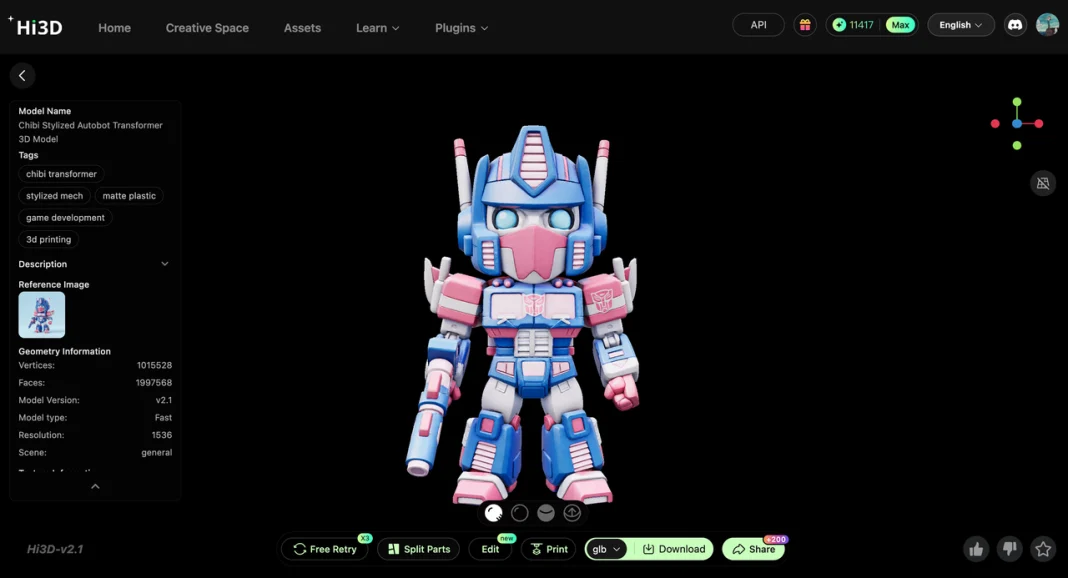
Hi3D marked its first anniversary on June 27, 2026, with a new AI manufacturing workflow for 3D printing. In Hong Kong, the company aimed the release at fans of building-block collectibles, mecha figures and designer toys. The platform turns a text prompt into an original character model and then prepares that design for printing.
Before this launch, hobbyists often needed Blender, CAD tools, mesh repair software, slicers and advanced fabrication skills. According to the June 27, 2026, briefing, Hi3D now combines those steps in one workflow. That change reduces the need for professional modelling and illustration skills.
A project starts with a written character concept and visual description. Using a Blokees-style mecha example, Hi3D runs the prompt through its Nano-Banana 2 image engine. The system creates concept art optimised for 3D reconstruction. It also supports consistent multi-view generation for the head, torso, limbs, armor and weapon systems.
For collectors and hobbyists, that feature removes a major barrier to original character creation. Once the artwork is approved, Hi3D uses its Sparc3D high-precision generation engine to rebuild a full 3D model in about two minutes. Unlike some AI 3D tools built mainly for visualization, Hi3D produces watertight meshes for physical manufacturing.
The company says Sparc3D handles structural integrity, topology continuity and printability automatically. As a result, cleanup work that once took hours can drop to minutes. That speed targets users who want custom mecha designs without learning several software packages.
Print preparation tools
Large mecha models often create the hardest print-preparation work. To fit desktop printer build volumes, users usually split a figure into the head, torso, arms, legs and weapons. Traditionally, that work required manual editing in Blender or CAD software.
Hi3D’s intelligent segmentation system analyses the model and separates it into logical printable components. The platform then generates matching connector structures for assembly. These include mortise-and-tenon joints and ball-joint assemblies.
Meanwhile, Hi3D’s Press-Fit Tolerance system calculates assembly clearances from printer specifications, nozzle size and material characteristics. Because of that step, printed parts can be assembled with less trial and error. The feature is designed for makers using common desktop 3D printers.
After model preparation is complete, the workflow moves into print setup. Hi3D’s smart build plate optimization system adjusts orientation and support strategies based on model geometry. Character figures prioritise surface quality, while mechanical components focus on reducing support material and shortening print time.
The final output is an enhanced 3MF file compatible with Bambu Studio, OrcaSlicer, Creality Print and Elegoo Slicer. Following that export, users can move from concept generation to production-ready print files in one workflow. Hi3D presented the system on June 27, 2026, as part of its first-anniversary release.
Last updated: 29 June 2026, 11:45 am

