

Wild Horse Nine weaponises John Malkovich’s chaotic energy to tell a sad yet hilarious story about male friendship.
Two murderers go on a holiday at some beautiful location and suffer through a melancholic journey of self-doubt. Oh, the older murderer records his thoughts on a tape recorder so it can be turned into some written work someday. There’s a joke about having a couple of nickels in here since director Martin McDonagh essentially combined his In Bruges and Seven Psychopaths screenplays for Wild Horse Nine, but setting this movie against the grim backdrop of the 1973 Chilean coup d’état brings a new level of grounded and emotional honesty to his usual brand of sad male friendships.

For much of the first act, Wild Horse Nine plays out like an absurdist buddy comedy where nothing much happens. Having just played a key role in setting the aforementioned coup in motion, Chris (John Malkovich) and Lee (Sam Rockwell) are headed to Easter Island on some irrelevant CIA mission. As the pair explore Easter Island and its famous moai, cinematographer Ben Davis, who’s worked with McDonagh on the director’s previous three movies, captures the island’s beauty with gorgeous wide-angle and helicopter shots that could’ve been taken from McDonagh’s 2022 ode to Ireland, The Banshees of Inisherin. As the movie lulls us into a contemplative mood with the geography, we’re also getting (real) world-building and character beats couched in banter that would make Aaron Sorkin envious.
McDonagh has always been a master of the back-and-forth between wisecracking weirdos, and he’s on fire in Wild Horse Nine. ‘You’re always eating, except when you’re sleeping or if you’re shooting a guy,’ says Chris, the no-nonsense, philosophical rambler to Lee’s exasperated straight-man foil, which leads to a great bit about Czechoslovakia. Underneath the dark comedy, these witty conversational cul-de-sacs constantly hint at or reveal tidbits about their history. How many meals have they actually had together? Did these meals take place during CIA missions? How long have they been doing this? Why is Lee always eating?
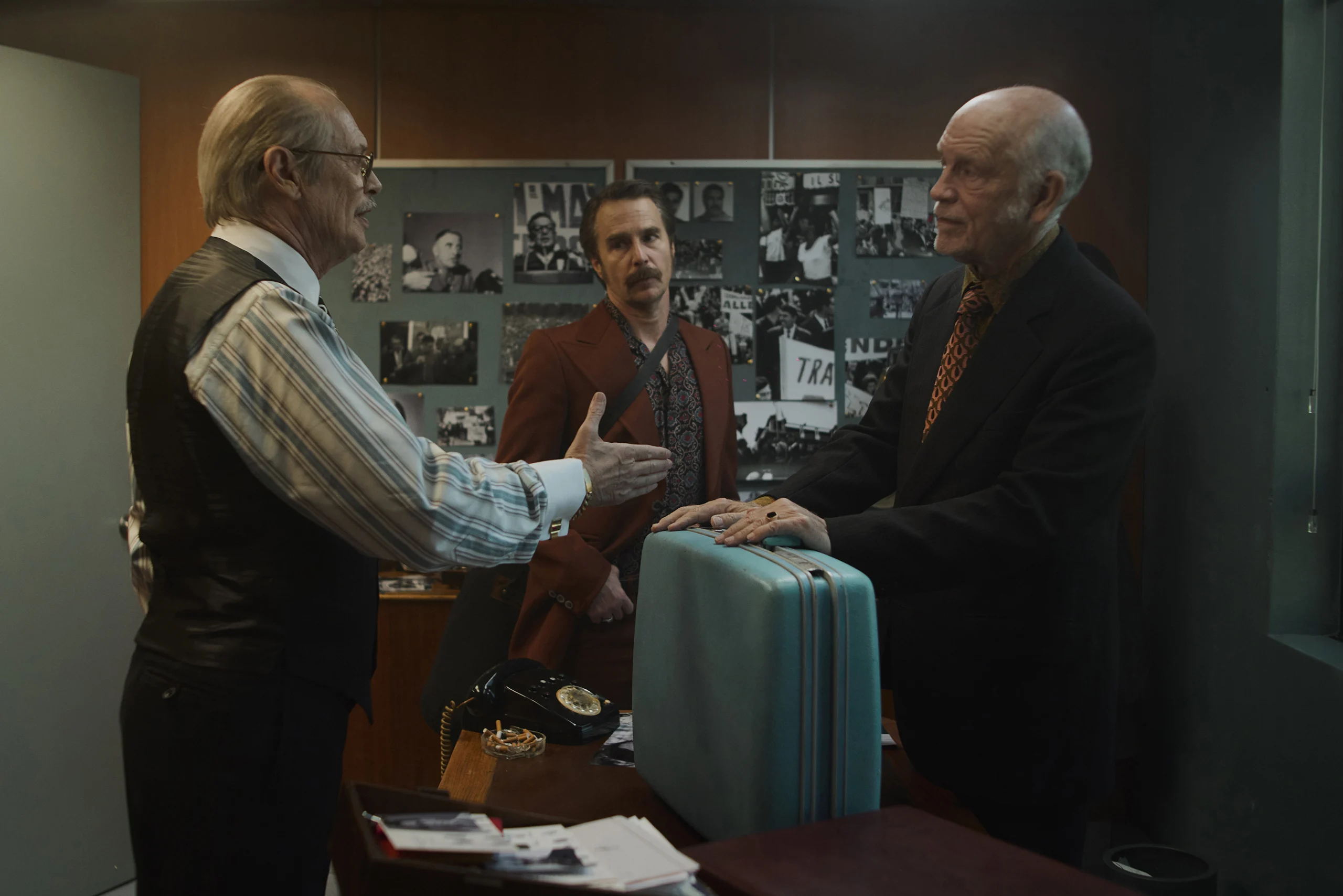
It’s fitting we get plenty of eating or drinking moments in Wild Horse Nine because these are appetisers to some of the harder-hitting emotional moments, particularly from Malkovich.
Taking his usual chaotic energy and steadily drip-feeding it to us, Malkovich upstages every 2026 performance in showcasing the weariness of a man who’s lived a life with weighty consequences. We get a hint of it pretty early on when he and Lee are at the airport and he tries to chat up two young Chilean women, Monica and Alicia (Mariana Di Girólamo and Ailín Salas), about their country’s Marxist president, Salvador Allende, telling them with a sneer, ‘Enjoy him while you can, ladies.’ When he’s waxing lyrical about dinosaurs one minute before talking about how ‘you only have to taste American cheese once to understand why we lost Vietnam,’ you get the sense that he’s got enough life experience to be well beyond the ‘find out’ stage and firmly in the acceptance stage of his life.

While the inciting incidents for each of McDonagh’s previous movies are fictional, the use of real events in Wild Horse Nine adds an extra dimension to Chris’s constant meditations on life, which is bolstered by Malkovich’s trademark whispering vocal quality. Killing a kid by accident as Ray does in In Bruges is awful, but being responsible, to varying degrees, for the many thousands of real deaths during the 1973 Chilean coup d’état is next level awful. As the true purpose of the Easter Island mission is revealed in act two and the consequences (a recurring theme) come home to roost in act three, it’s no wonder why Chris is always philosophising and commenting on everything: he’s processing it all as it catches up to him in real time.
So, where exactly does Lee fit into all of this? He’s Chris’s colleague, yes, but it’s far more than that. It’s a combination of an office husband, platonic life partner, and mentor. He’s been through a lot with Chris, and for all their seeming friction, Rockwell, who oozes charm out of every pore, sells their unbreakable bond with ease without turning Lee into a doormat. I definitely believe it when Lee says he can’t spell Czechoslovakia. As he goes through his own crisis, it reinforces an undercurrent of sadness in Wild Horse Nine. When Lee wearily calls his wife (Parker Posey) and asks how their kids are, only for her to reply, ‘who cares?’, it’s gutting because he, like Chris, is aware of the machinations happening but has sailed past caring and is buried deep in the acceptance stage.

You can also extrapolate the ways McDonagh is using the 1973 Chilean coup d’état as a way to comment on the awful geopolitical happenings in 2026, but that’s ultimately incidental to the movie’s bromance throughline, as somewhat distracting as this element is on occasion. But the thing that separates Wild Horse Nine’s protagonists from McDonagh’s other characters is the surprising lack of regret or anger.
Chris and Lee argue over the dumbest things, but they’re never yelling at or mad at each other. Not genuinely. For all the cynicism projected by the pair about their life and history as CIA agents, this is a very emotionally honest movie. In fact, it’s arguably McDonagh’s most hopeful movie despite it being set during a hopeless period of history. The pair may lie for a living as CIA agents, but they’re open with each other. At worst, they lie by omission – clearly scar tissue from the paranoia that comes with being a CIA agent during the 70s – but it’s never done with malice.

Wild Horse Nine wants us to like both its protagonists as much as McDonagh does, but it won’t gloss over the nasty parts to get us there. Make no mistake, both Chris and Lee are objectively awful people, but their collective jadedness makes it easy to root for them because, well, being jaded is quite relatable. That and how well Malkovich and Rockwell sell their verbal Laurel and Hardy schtick.
At the end of the day, once everything is said and done, and we’re shuffled off this mortal coil, Wild Horse Nine makes a pretty convincing case that as long as you go out with no regrets and the people you love know that you love them, then you’re doing okay. As Chris muses into his tape recorder, ‘I’m going to say a poem, which is strange because I suck at poems, but I met this horse and it taught me how to not be afraid,’ accepting whatever your lot in life is bloody difficult but definitely possible.
Wild Horse Nine is a deeply funny and melancholic bro’s weekend away
Wild Horse Nine weaponises John Malkovich's chaotic energy to tell a sad yet hilarious story about male friendship.
-
Story4.5 out of 5
-
Performances5 out of 5
-
Direction4.5 out of 5
-
Craft5 out of 5
Our visit was hosted. The score and opinions are ours alone.