

Perceptual Relief Masks Real Risk
Monash University conducted a cycling safety study that found cyclists often feel more secure than they are on busy streets, revealing a critical gap between perceived and actual risk.
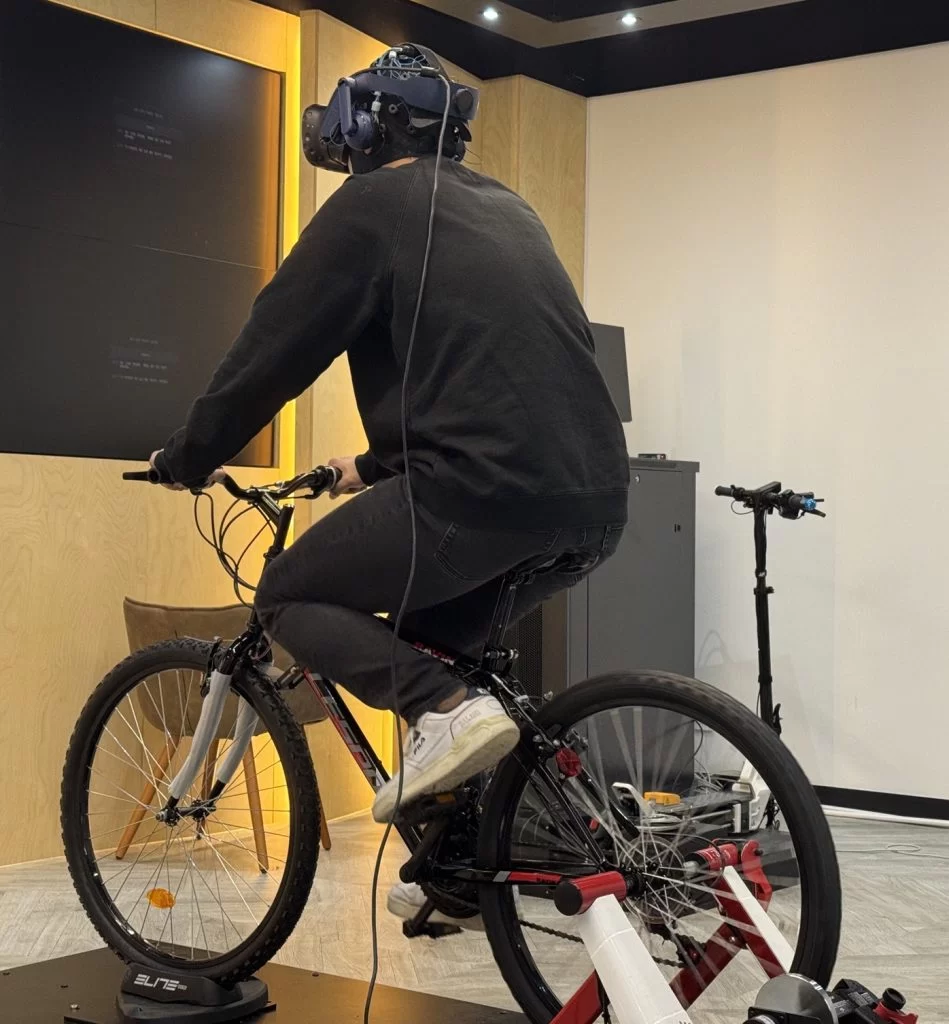
The study involved 72 cyclists using a fixed-base bicycle simulator. Researchers used immersive virtual reality and real-time brain monitoring to observe responses to changing traffic scenarios.
After a vehicle overtakes cyclists, they experience a ‘perceptual relief period’ where they feel safer. However, the risk from vehicles behind them remains significant, said lead author Lurong Xu, a PhD candidate at the Department of Civil and Environmental Engineering.
Study Reveals Design Insights
The research highlighted that greenery and enclosed street environments contribute to a false sense of security for cyclists. These features may make streets appear safer, lowering cyclists’ alertness to potential dangers.
“Trees, enclosed streets and visually rich surroundings can make a street feel calm and inviting,” Ms. Xu stated. “But in high-risk spots where cyclists and cars are in close interaction, those same features can create a false sense of security, lowering alertness and masking real risks from nearby vehicles.”
The study also calculated the ‘time-to-collision’ (TTC), estimating how long it would take for a vehicle to collide with a cyclist if neither changed speed or direction. This measurement helped identify moments where perception and actual risk diverged.
While the experimental street layout was based on a real-world setting in China, the principles are applicable globally, including in Australian cities where cyclists frequently share roads with motor vehicles.
Xu emphasised the need for collaboration between transport engineering, urban design, and neuroscience to improve cycling safety. “These insights have value for urban environments globally where cyclists and drivers share space because they’re based on human biology,” she added.
The core takeaway from the study is that feeling safe is not the same as being safe. This universal pattern is rooted in how the human brain processes risk, captured through precise data. “Perceptions of safety are shaped by local street design, geography, and driving culture,” Ms. Xu noted. The principles identified can help cities ask better questions about how streets are experienced in real-time.
Last updated: 29 June 2026, 12:19 pm