

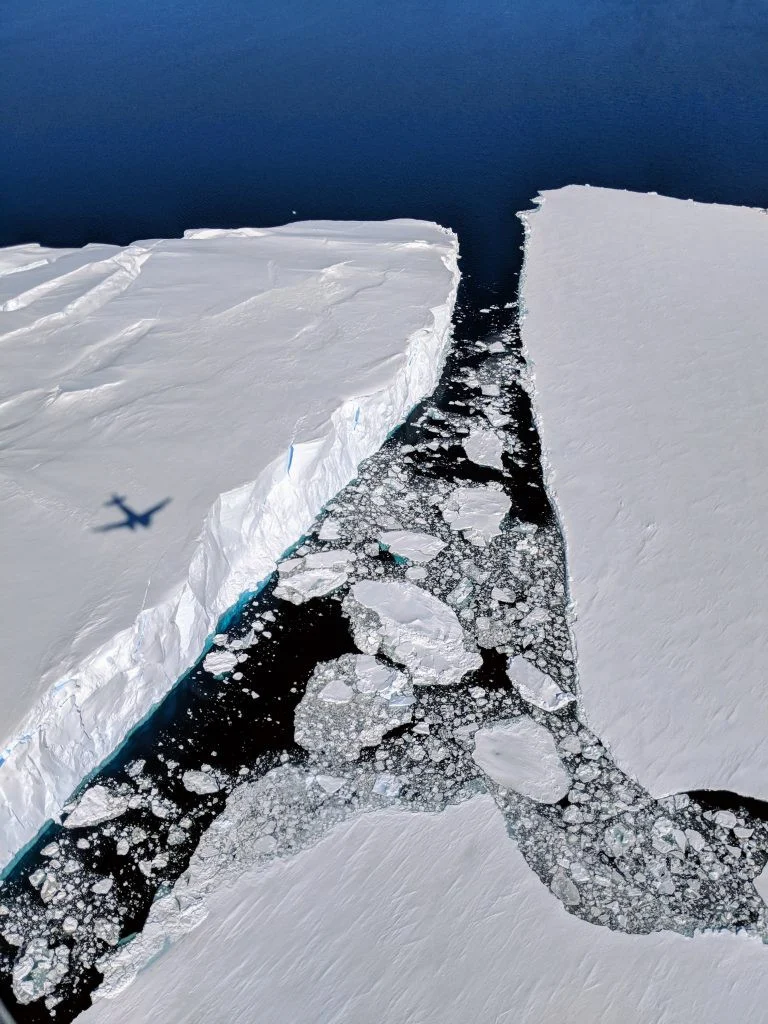
Antarctic coast plan spans 80 scientists in 16 countries
A team of 80 scientists from 16 countries has proposed continent-wide surveys of the Antarctic coast to improve projections of future sea-level rise.
The plan centres on three circumpolar survey rings around Antarctica, aimed at tracking inland ice flow, grounding zones and ocean-facing ice shelves. The work is outlined in a review published in the American Geophysical Union’s Reviews of Geophysics.
Australian researchers are part of the effort, including Dr Felicity McCormack, a Chief Investigator at Securing Antarctica’s Environmental Future based at Monash University, and Dr Chen Zhao, a Chief Investigator at the Australian Centre for Excellence in Antarctic Science and ice-ocean systems analyst with the Australian Antarctic Program Partnership at the University of Tasmania.
Three rings around Antarctica
Dr McCormack said the surveys would track the processes driving ice loss. “Scientists would run three continent-wide survey rings around Antarctica – tracking inland ice flow, grounding zones and ocean-facing ice shelves to capture the critical processes driving ice loss,” she said.
The review said incomplete data on coastal bed topography and sub-ice shelf cavities remain a major limit on estimates of Antarctic ice loss and future sea-level rise. It said satellite observations can measure ice motion and surface change, but cannot observe the bedrock under the ice from space.
Australia has contributed to Antarctic bedrock mapping through the ICECAP airborne geophysics program, which the researchers said has produced some of the most detailed bed-topography measurements of the East Antarctic margin to date.
The work was coordinated through the Scientific Committee on Antarctic Research RINGS Action Group and is endorsed by the Council of Managers of National Antarctic Programs. First author Dr Kenichi Matsuoka of the Norwegian Polar Institute said internationally coordinated surveys could help build more complete datasets and serve as a stepping stone towards the next International Polar Year 2032, 33.