

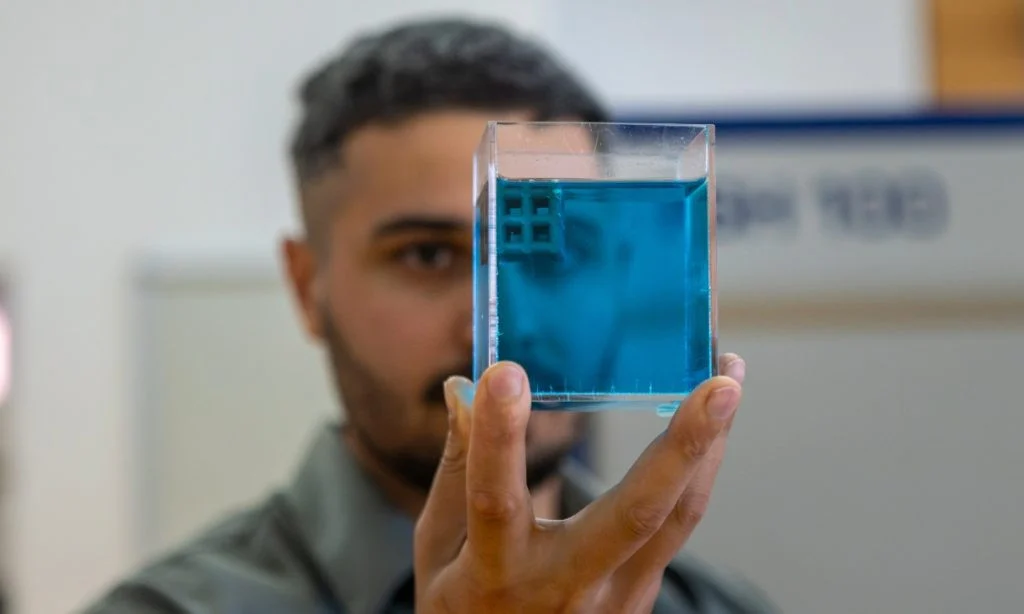
Floating titanium stayed buoyant for more than two months
A 3D-printed floating titanium material developed by RMIT University researchers stayed buoyant in freshwater for more than two months and is being pitched for marine infrastructure.
RMIT said the lattice is made of hollow, interconnected titanium struts filled with polyurethane foam, allowing water to flow through the structure while keeping it afloat. The study, published in Advanced Materials, is described by the university as the first reported demonstration of a floating metal-hybrid lattice metamaterial.
Lead researcher Dr Jordan Noronha from RMIT’s Centre for Additive Manufacturing said the team had addressed a long-standing problem with metallic lattices, which can be very light but usually sink because water enters their open spaces. “By filling only the hollow titanium struts with polyurethane foam, we created a structure that allows water to flow through it while remaining buoyant even after significant cracking and damage,” Noronha said.
The researchers also developed a measure they call skeletal density, which considers only the parts of the structure that exclude water. Noronha said the design rule is simple: if the skeletal density is lower than the surrounding liquid, the structure will float.
Seawater and damage tests
RMIT said testing found the floating titanium structure was 70% stronger than stainless steel or high-density polyethylene used in marine applications when compared at the same overall density.
In short-term corrosion testing using natural seawater from Melbourne’s Port Phillip Bay, the lattice lost 0.15% of its mass after two weeks of immersion and its strength declined by less than 1%.
The material remained buoyant after cracking, failure at key connection points and the fracture of an entire lattice layer, according to RMIT. It sank only after being severely crushed and compacted.
The team also produced a 3D-printed marine buoy, which RMIT said remained stable in a turbulent seawater tank rotated up to 45 degrees without a sealed casing, protective coating or extra flotation. Project leader Distinguished Professor Ma Qian said the next stage would involve scaling up the demonstration parts and testing long-term performance under realistic marine and deep-sea conditions.