


Avatar: Fire and Ash is basically a clone of the previous movie, but James Cameron’s blockbuster filmmaking mastery elevates it to a must-see event.
It’s almost baffling to realise that James Cameron has only made 10 movies over the course of his highly successful four-decade-plus career as a top-tier Hollywood director, nearly all of which had some kind of seismic impact on the way blockbuster cinema is made. The Abyss gave us the first CGI character, Terminator 2 upped the scale of practical action set pieces while blending in CGI elements, Titanic is the ultimate disaster movie, and Avatar remains the pinnacle of performance-capture technology.
It’s also crazy to note that of Cameron’s 10 movies, five are sequels and two of them are Avatar movies. Discounting Piranha 2: The Spawning because it doesn’t exist in his world, Cameron has a way of elevating sequels on both a thematic and action set piece scale that no one has been able to match (so far).
The man knows how to make a good sequel and revolutionary blockbuster fare, so it’s all the more jarring to watch all 197 minutes of Avatar: Fire and Ash and come out of it thinking, “huh, that was just good.” A gentleman’s 7 if you will.

Taking place a year after The Way of Water, Fire and Ash sees the Sully family dealing with the death of Neteyam in their various ways. Jake (Sam Worthington) is distant from everyone and is working through his grief via salvage diving. His son, Lo’ak (Britain Dalton), feels tremendous guilt over his brother’s death, while his partner, Neytiri (Zoe Saldana), is lost at sea (pun intended) as she’s struggling to process her pain in a foreign environment that’s far from home.
There’s little time to regroup and process their trauma because the series’ big bad, Quaritch (Stephen Lang), is still alive and will stop at nothing to get at the Sully family out of revenge. Plus he’s not a fan of his biological son, Spider (Jack Champion), being a Sully in all but skin colour and the ability to breathe in Pandora’s air. Since the Na’vi triumphed in the last skirmish, Quaritch decides to change things up by enlisting Varang (Oona Chaplin) and her fire-loving, red war paint-wearing Na’vi warrior cult called the Mangkwan.
Cameron has said that Fire and Ash was originally conceived as the second half of the previous movie, only to be spun off on its own due to its length. It’s clear that he and his writing team are trying to break down two movies of emotional scar tissue alongside the franchise’s themes of humanity co-existing peacefully with the environment, all to somewhat good effect initially. The first 20 or so minutes feature some beautiful ideas about guilt and loss, particularly Lo’ak’s opening sequence, and how to deal with pain as a family. In just a few scenes, Fire and Ash says a lot more about family than the entire Fast & Furious franchise.

Unfortunately all these new and interesting ideas quickly become lost among the introduction of a new Na’vi clan, a genuinely formidable new villain, and the need to show off Pandora’s beautiful environments. Almost as soon as we get a whiff of something new, something old comes along and elbows it out of the way.
For better and for worse, the narrative structure is exactly the same as The Way of Water: We get up to speed with where the Sully family and co are at, Quaritch and the evil corpos hatch their plan to catch Jake and/or harvest Pandora’s resources, a big battle ensues, complications and misunderstandings arise, brief reconciliation, and then a humongous final action set piece to cap it all off. But look, if the formula works – and it definitely has – then there’s no need to mess with it too much. It does mean that it lacks the usual surprise that new Cameron movies tend to have. The same goes for the characters and writing.
Like his approach to set pieces, Cameron’s writing remains engineer-like in its precision while any subtext remains rooted on the level of screaming “I’m the king of the world”. Nearly all the main characters remain surface level in their development and speak in clichés. Even with Chaplin turning in an MVP performance as Varang, she quickly becomes nothing more than Quaritch’s side arm as soon as he plonks a gun in her four-fingered hands and any semblance of agency is gone by the third act. That was bitterly disappointing to watch given how well Cameron has typically written strong female characters in the past.
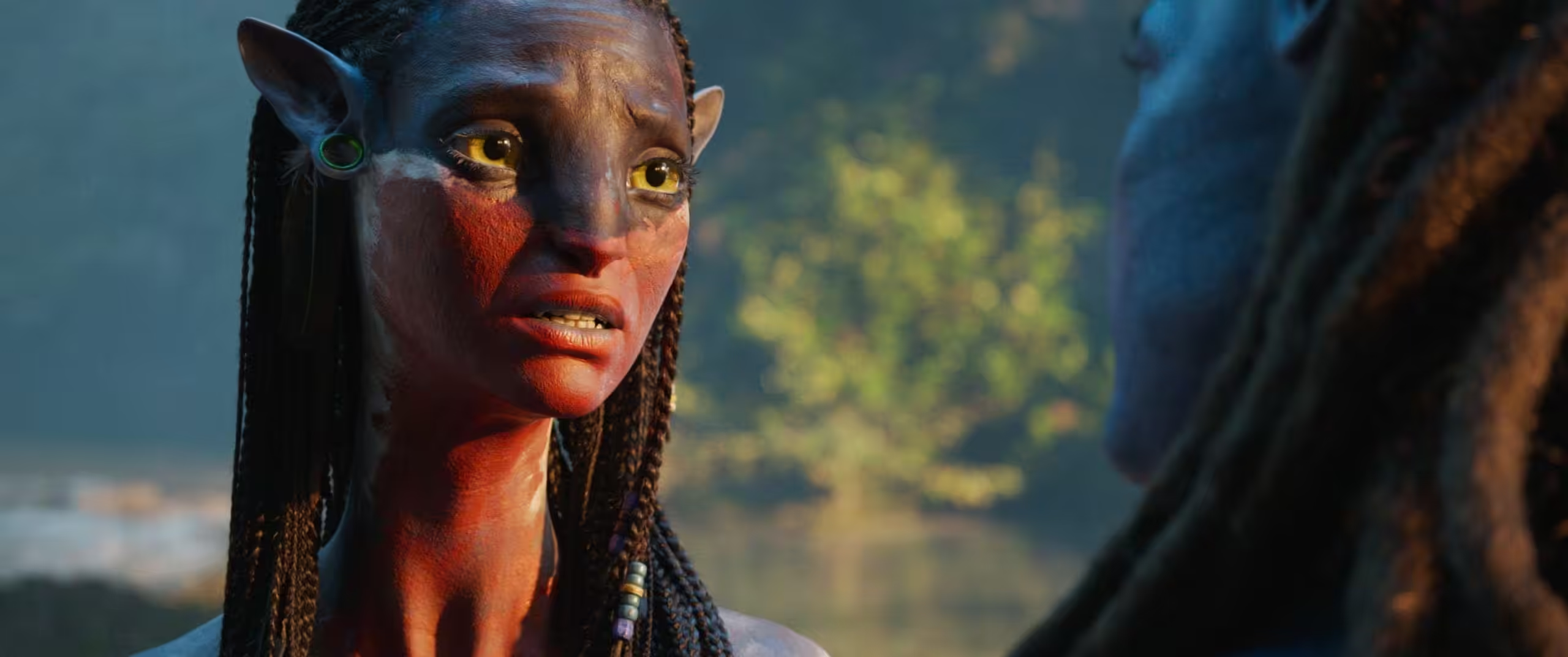
Okay, so Avatar: Fire and Ash is basically a rehash of The Way of Water in almost everything except the title, but the big question is whether it is entertaining or not. Well, despite all the storytelling and writing flaws, I was thoroughly entertained throughout.
The visuals and performance capture are a feast for the eyes. The jump in quality from the previous movie isn’t anywhere near as drastic as the jump from Avatar to The Way of Water, but every single square centimetre of the screen is still the best-looking thing you’ll see in a cinema today. Cameron definitely hasn’t lost his visual flair and there are some majestic sights on display here, like the Wind Traders’ giant floating tentacle ships and the variety of glow-in-the-dark flora populating the forests and seabeds.
Action set pieces remain Cameron’s sharpest weapon in his arsenal though. Unlike the rapid-fire CGI mess we see in most Hollywood slop these days, Fire and Ash is all about epic sweeping shots that are easy to track, massive scale that isn’t confusing, and immaculate staging. Having said all that, we’ve seen these action sequences already. Cameron is more or less taking all the water and air battles of the first two Avatar movies and redoing them in higher fidelity. But when you’re cloning some of the best action scenes to be put on the big screen, even a highly polished copy-and-paste job is better than 99 per cent of anything else out there.
Cameron has said that he’s ready to walk away from the Avatar franchise should Fire and Ash not perform well, which is a bit strange coming from him given how typically bullish and self-confident he is. But it certainly explains the sense of sameness and lack of novelty on display in Fire and Ash. No one is going to mistake Avatar: Fire and Ash as a masterpiece. Hell, I don’t think it’ll rank as the second best Avatar movie. But even a sub-par James Cameron effort remains some of the most entertaining blockbuster fare we’ll see today. If this is indeed the final time we visit Pandora, then it’s been a fun ride, flaws and all.