

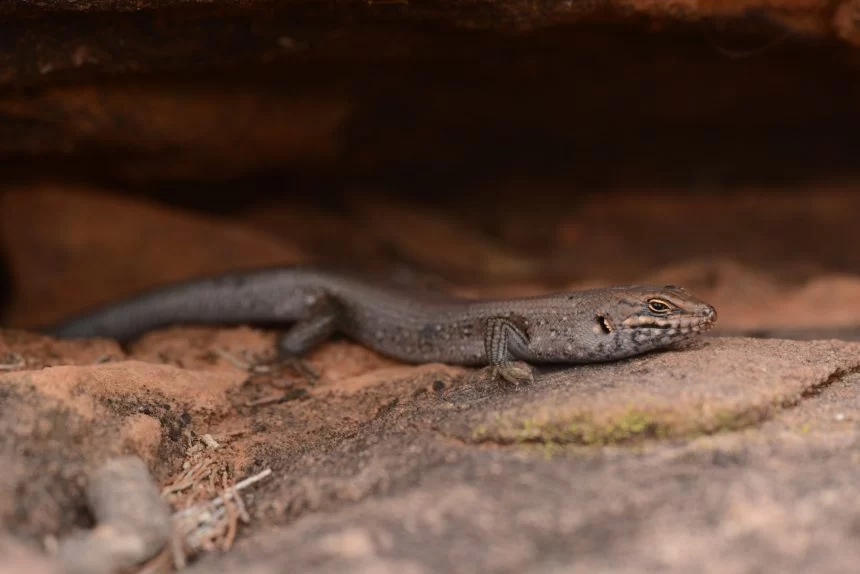
Endangered Skink Found in Mutawintji Park
On April 14, 2026, a new skink species known as Kungaka was officially identified in Mutawintji National Park, located north-east of Broken Hill, Australia. With fewer than 20 individuals known to exist, the Kungaka is classified as one of Australia’s most threatened reptiles.n
This discovery resulted from a partnership between the Wiimpatja Aboriginal Owners, the NSW National Parks & Wildlife Service, and scientists from the Australian Museum Research Institute. The skink, scientifically named Liopholis mutawintji, is unique to the Mutawintji region.n
Penny Sharpe, Minister for the Environment, highlighted the significance of this finding. She remarked, “Our conservation efforts are helping identify at-risk species to ensure we act quickly to secure their future.” The discovery of the Kungaka in the rugged gorges is an exciting moment and a reminder of the need for protection.n
The Threats to Kungakan
Previously considered part of the widespread White’s Skink population, recent genetic analysis confirmed that Kungaka is a distinct species. Feral goats threaten the skinks by degrading their habitat, while introduced predators like cats and foxes also pose risks. Climate change exacerbates these challenges by intensifying heat and drought.n
Dr. Jodi Rowley, Curator of Amphibian and Reptile Conservation Biology at the Australian Museum, emphasised the importance of collaboration in preserving the skink, stating, “With potentially fewer than 20 individuals remaining, the Kungaka stands on the brink of extinction.”n
The Mutawintji Board, supported by the NSW National Parks & Wildlife Service, plans to continue surveys to better understand the Kungaka’s needs and develop conservation strategies. Warlpa Thompson from the Mutawintji Board of Management expressed the cultural significance of the skink, noting, “Our people have been leading the way in looking after this extremely rare lizard.”n
Lead author of the research paper, Tom Parkin, described the Kungaka as representing an ancient lineage. This lineage likely originated early in Australia’s history. Parkin noted, “Through this research, we not only better understand a species but also the history behind the surrounding environment.”n
The Kungaka survives within a small, isolated pocket of sheltered gorge in Mutawintji. This area is surrounded by hot saltbush and gibber plains, approximately 500 km from its closest relatives. Feral goats pose a significant threat by degrading the local habitat through overgrazing and trampling, which reduces food availability and shelter, exposing lizards to predators and extreme temperatures.n
Introduced predators, such as cats and foxes, add to the risks faced by the Kungaka. Conservation efforts are critical in addressing these threats. The collaborative partnership between scientists, First Nations Custodians, and government departments is essential for the skink’s survival. Continued monitoring and evaluation are required to ensure the Kungaka’s future.
Last updated: 29 June 2026, 12:28 pm