

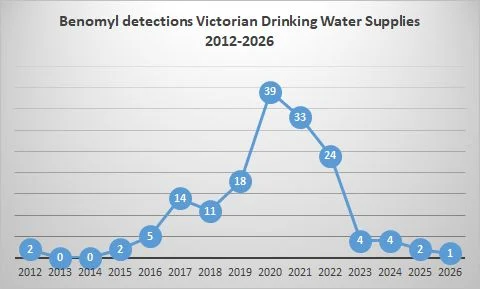
Benomyl detections hit 141 across 43 supplies
Benomyl detections were recorded 141 times in 43 Victorian drinking water supplies between 2017 and 2026, despite the fungicide being banned in Australia in 2006.
The detections were identified in raw water monitored by Central Highlands Water, Grampians Wimmera Mallee Water, Lower Murray Water and North East Water. Benomyl was the sixth most frequently detected pesticide in Victorian water supplies over the period.
Average Benomyl levels were 0.03μg/L, or about 0.03% of the Australian drinking water guideline of 90μg/L. All detections were in untreated raw water, and the risks to drinking water would be lessened by treatment processes such as Powder Activated Carbon, according to the information provided.
The highest amount detected in a water supply was 0.26μg/L at Tullaroop Reservoir, north of Ballarat. A small farm channel south of Shepparton, outside a domestic water supply, recorded the state’s highest Benomyl detection at 0.54μg/L.
Quambatook and Tullaroop detections
Quambatook recorded the most detections, with 15 between 2018 and 2026 averaging 0.043μg/L. Lake Fyans, St. Arnaud and Tullaroop Reservoir each recorded nine detections, while Centenary Reservoir recorded eight.
Friends of the Earth Land Use Researcher Anthony Amis said: “From almost 2000 pesticide detections detected by water authorities across Victoria, Benomyl was the sixth most frequently detected pesticide with 141 detections in 43 different water supplies. Five separate water authorities reported Benomyl. How on earth is this fungicide still being detected 20 years after it was banned in Australia?”
Amis said it was possible a closely related chemical had been detected and listed as Benomyl by laboratories. Benomyl can rapidly degrade into Carbendazim, and the water authorities that detected Benomyl did not test for Carbendazim, Thiabendazole or Thiophanate Methyl.
About one quarter of detections were above 0.029μg/L, which the information cited as a proposed 99% ecotoxicity threshold value for Carbendazim in Queensland. There are no ecological guidelines for Benomyl or Carbendazim in Australia.
The Victorian data was obtained through Freedom of Information requests covering 2017 to 2025, and similar requests in 2016 revealed nine Benomyl detections.
Related Articles
Last updated: 28 July 2026, 8:25 am