

Novel Method Reveals 27 Planet Candidates
A team of astronomers from UNSW Sydney has discovered 27 potential new planets orbiting double star systems, reminiscent of Star Wars’ Tatooine, using an innovative planet-finding method.
The study, published in the Monthly Notices of the Royal Astronomical Society, identifies these circumbinary planet candidates by observing changes in the orbital patterns of binary stars using a technique known as apsidal precession.
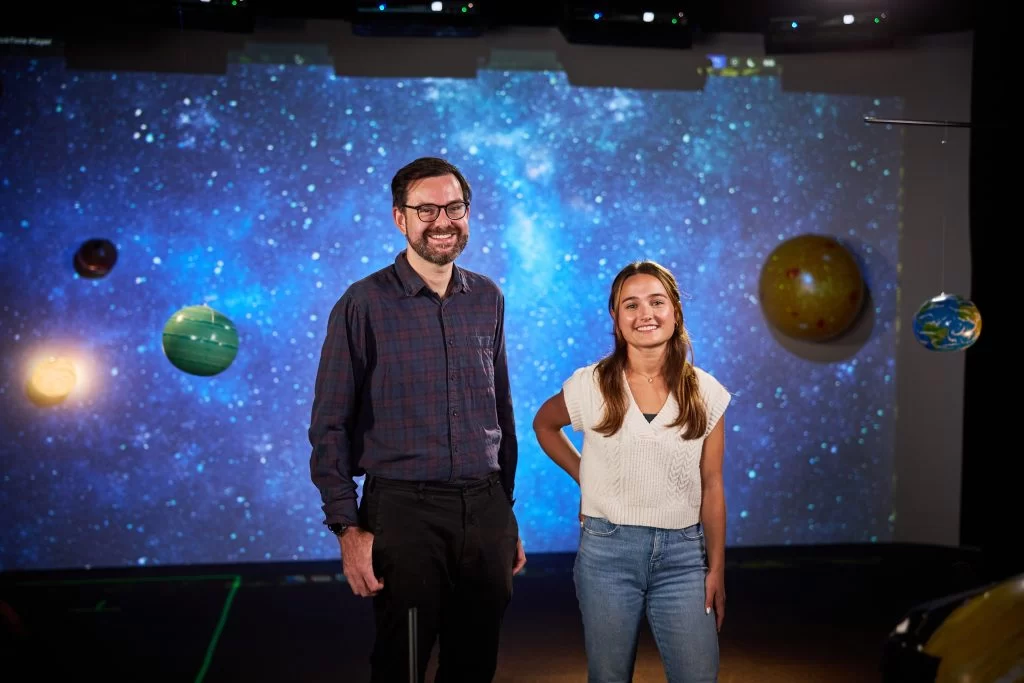
Lead author Margo Thornton, a PhD candidate at UNSW, explained, “This new method could help us uncover a large population of hidden planets, especially those that don’t line up perfectly from our line of sight.”
A New Approach to Planet Hunting
The apsidal precession method monitors variations in the orbital schedule of binary stars, which may indicate the presence of a planet. This approach broadens the range of planets that can be detected, beyond the traditional ‘transit’ method which relies on planets crossing in front of their stars from Earth’s perspective.
Using data from NASA’s Transiting Exoplanet Survey Satellite (TESS), the team identified these candidates among 1590 binary star systems, suggesting that nearly 2% of such systems could host planets.
Scientia Associate Professor Ben Montet, co-author of the study, remarked, “I wasn’t expecting to find 27 already at this point from the pilot study. Now we get to start the really fun project of figuring out which ones are real planets.”
The potential planets range in size from those similar to Neptune up to ten times the mass of Jupiter, located between 650 and 18,000 light years from Earth, scattered across both the southern and northern skies.
Further research will involve confirming these candidates as planets through additional observational methods. The UNSW team plans to collaborate with international researchers and utilise the Anglo Australian telescope to study the spectra of these binary stars.
The discovery of circumbinary planets is significant because only 18 such planets have been confirmed before this study, making these new findings a substantial addition to the known catalogue.
These findings could reshape our understanding of planetary formation and the types of environments that may exist in other solar systems. The study’s release coincides with May the 4th, known as Star Wars Day, adding a thematic connection to the fictional Tatooine.
As astronomers continue to explore these systems, the discovery of circumbinary planets provides new insights into planetary formation and the potential for habitable environments beyond our solar system.
Last updated: 29 June 2026, 12:15 pm