

New Research on Hypersonic Behaviour
Tiny particles within rocket engines travel at hypersonic speeds, influencing future spacecraft design by enhancing durability and safety, according to Monash University research. Published on 2nd June 2026, the findings challenge previous assumptions about particle behaviour during rocket launches.
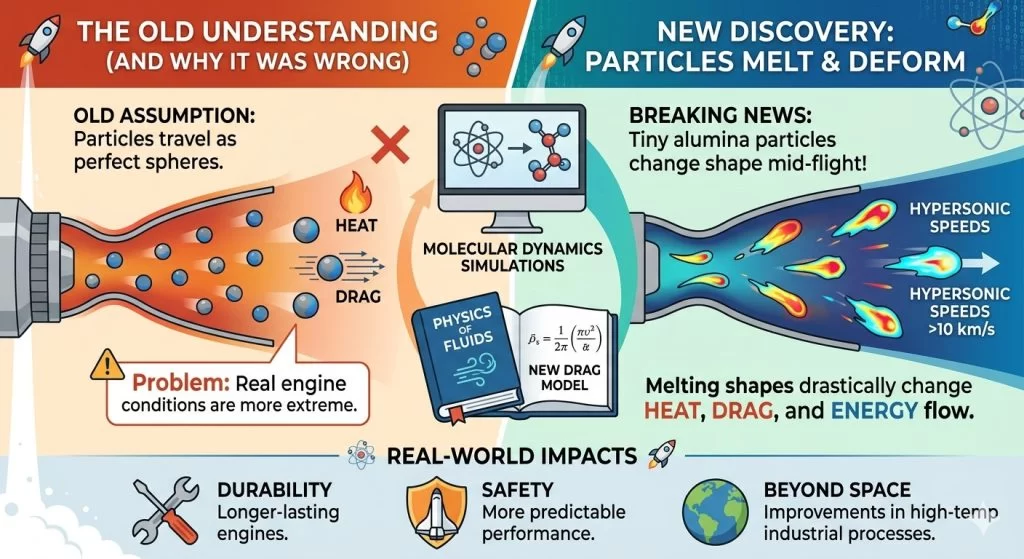
Particles, previously thought to stay spherical, actually melt and deform mid-flight, altering heat and energy transfer in rocket systems. This discovery led to a new drag model that predicts particle behaviour under extreme conditions more accurately.
Associate Professor Qijun Zheng from Monash’s Mechanical and Aerospace Engineering department stated, “Inside rocket motors, these nanoparticles are exposed to enormous temperatures, pressures and speeds.”
Microscopic alumina particles, formed when aluminium fuel burns inside solid rocket motors, can reach speeds up to 10 kilometres per second through nozzles. Molecular dynamics simulations were used to study their behaviour.
At hypersonic speeds, particles experienced intense air molecule collisions, causing rapid heating and melting. Smaller particles heated faster due to larger surface area exposure relative to their size.
Impact on Aerospace Technology
Molecular dynamics simulations, a type of atom-by-atom computer modelling, tracked how nanoparticles behaved in high-temperature, high-pressure air. These tools provided insights into particle interactions with air under extreme conditions.
Molten particles often stretched into thin “bag-like” structures before collapsing back into new forms during flight. These changing shapes affect heat and energy flow, crucial for predicting wear and performance inside rocket systems.
Associate Professor Zheng noted, “Current engineering models often assume particles remain perfectly spherical, but our work shows that assumption no longer holds under these extreme conditions.”
Improved modelling could lead to better propulsion system designs and more accurate material wear predictions inside rocket engines. The study involved researchers from the Southeast University–Monash University Joint Research Institute, Monash University, and Shanghai University.
Besides spacecraft design, the findings may apply to other high-temperature industrial processes, including atmospheric re-entry and energy systems, where nanoparticles are involved.
Related Articles
Last updated: 29 June 2026, 11:55 am