

Fluency Lacking Despite High Adoption Rates
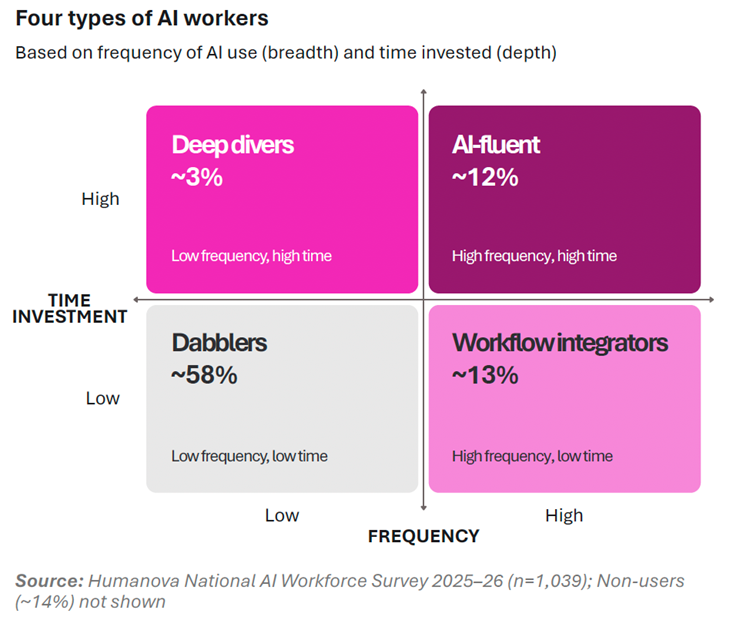
A new study reveals that while 70% of Australian office workers use AI regularly, only 12% have developed the fluency needed to collaborate effectively with these technologies. The Humanova National Workforce Report 2026 highlights a growing gap in AI capability across workplaces in Australia.
The report, based on a YouGov survey of over 1,000 knowledge workers, indicates that the majority of employees are ‘dabblers’ who use AI occasionally but lack deeper skills. It also shows that senior leaders are significantly more likely to be AI-fluent compared to the average office worker.
“Adoption is not the same thing as capability. You don’t solve the second problem by celebrating the first,” Dr Sean Gallagher, Founder of Humanova and author of the report, explained. His insights suggest organisations are at risk of reducing their workforce without sufficient AI readiness.
Senior Leaders Ahead in AI Fluency
The report finds a stark contrast in AI fluency between different levels of an organisation. One in four senior leaders have developed AI fluency, while only one in twenty office workers have done the same. This gap is attributed to leaders spending more sustained time working alongside AI.
Senior leaders are also three times more likely to engage deeply with AI, which is crucial for developing ‘AI intuition’, the ability to judge AI output reliability and delegate tasks effectively. This disparity creates a two-tier workforce, with leaders more prepared for AI integration than their subordinates.
Joseph Lyons, President of ELMO Software, described how his company successfully bridged this gap through cultural change and structured training. He remarked, “The challenge is no longer the time it takes to implement a good idea, but how quickly we can generate and test new ones,” highlighting the importance of AI fluency.
As AI agents become capable of executing complex tasks independently, the need for workers with AI intuition will increase. However, this could widen the divide unless organisations invest in building these capabilities among their workforce. The report stresses the need for comprehensive strategies to prepare employees for AI-driven change.
The Humanova report warns of execution risks associated with premature workforce reductions due to AI. It states that 26% of senior decision-makers see AI as a means to reduce headcount, a figure that rises to 32% in larger companies with more than 1,000 employees.
Gallagher emphasised the need for a cautious approach, stating, “The danger is that they cut before they build. If you make the organisation smaller before you make it smarter and more productive, AI becomes a cost-cutting story that brings risk, rather than a transformation story that delivers value.”
Related Articles
- Australia Risks Losing Lead in Green Iron and Steel
- Nepean By-Election: Key Players and Stakes
- Dubai Sets Record for Electricity Service Continuity
Last updated: 29 June 2026, 12:17 pm