

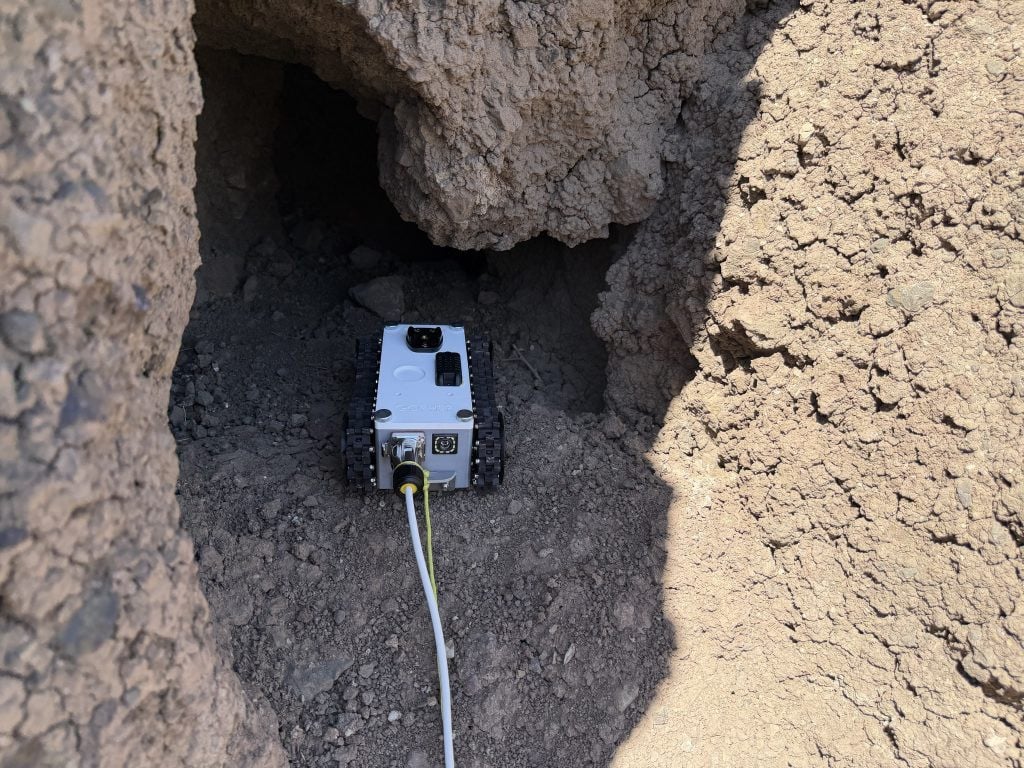
Robot can gather data up to 25 metres below the surface
La Trobe University-designed robot Gopher has been deployed in eastern Türkiye as an international team drills and takes core samples at a site linked by some to Noah’s Ark.
Near Mount Ararat, the lightweight remote-controlled machine is operating at the Durupınar Formation, a boat-shaped geological feature.
Some believe that feature could be connected to the vessel described in the Book of Genesis in the Bible, although claims about Noah’s Ark remain highly contested.
Durupınar drilling begins near Mount Ararat
The collaboration with Noah’s Ark Discovery began nine months ago when Dr Ross read a news item calling for a robot to explore the area.
“It could be the archaeological discovery of the century but whether the site turns out to be Noah’s Ark or something completely different, it’s exciting to see our technology helping researchers investigate and better understand what’s there,” Dr Ross said.
Front and rear waterproof wide-angle cameras are fitted to Gopher, along with environmental sensors.
The robot enables researchers to collect data from locations inaccessible to humans. The robot enables researchers to collect data up to 25 metres below the surface.
In late July, the robot left Australia for Türkiye.
Gopher is a smaller version of WomBot, the original robot first developed in 2021.
Creating a smaller version suited to this type of exploration was straightforward for Dr Ross, who had already 3D-printed a similar model for armadillo burrows in South America.
According to La Trobe, the project has attracted global attention and marks an unusual role for Australian-designed technology in an international archaeological investigation.
Dr Ross said the robot could also be used in future to detect wildlife and support other archaeological discoveries.
Edward Szall, Head of Production at Noah’s Ark Discovery, is among the team members keeping Dr Ross updated on the investigation.
Harsh winter conditions can limit the work at the site, where temperatures drop well below freezing.
“We look forward to working with Robert and our other university partners for next season to improve and upgrade the drone, and thank him and La Trobe University for their crucial donation of time and resources,” Mr Szall said.
“It’s been fascinating to see where our technology can be applied,” Dr Ross said.