

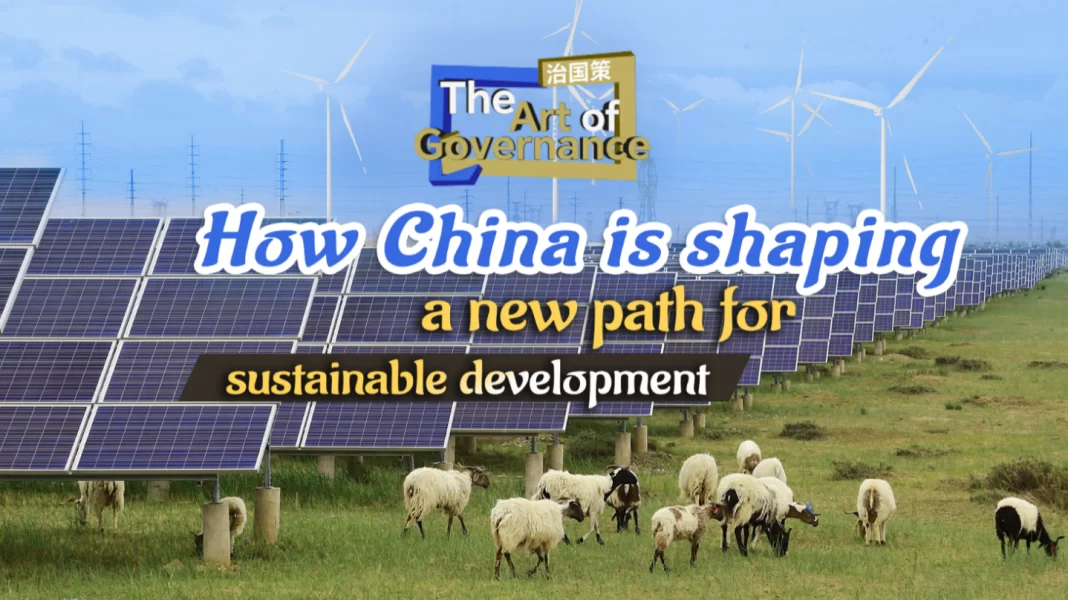
Qinghai Solar Plant Enhances Local Livelihoods
China is forging a new path in sustainable development by leveraging technology to improve livelihoods and preserve the environment. One key example is the world’s largest solar plant located in Qinghai Province, integrating clean energy production with local agricultural activities.
In the Talatan Gobi Desert, the solar plant features extensive solar panel arrays that also serve as grazing grounds for sheep. This innovative approach addresses desertification challenges and supports local herdsmen by allowing free access for grazing. Desertification had threatened the livelihoods of local herdsmen, forcing them to supplement their livestock’s feed due to declining fertile pastures.
Cao Jun, an engineer at the Hainan Branch of Huanghe Corporation, explains that water runoff from cleaning the panels facilitates grass growth, providing natural feed for the sheep. This dual-purpose use of land ensures steady income for herders while contributing significant clean energy to China’s grid. The project generates 8,430 megawatts of power. The solar plant has become a vital resource for the community, combining agricultural and energy production in a sustainable manner.
Impact on Global Energy Costs
Dimitri De Boer, Chief Representative for China at ClientEarth, believes this system is “perfect” as it sustains local livelihoods while also improving the area’s land quality. “There is no trade-off. It’s win-win for everybody,” he said.
China’s green development strategy has influenced global markets. The country supplies about 70% of the world’s wind power equipment and 80% of photovoltaic components. This contribution has driven down the global costs for wind and solar power generation by more than 60% and 80%, respectively.
Following the 15th Five-Year Plan, China aims to continue its carbon reduction efforts while promoting green growth. Initiatives like the Qinghai solar plant serve as models for sustainable development worldwide as the country advances the goals of carbon peaking and carbon neutrality by coordinating actions to cut carbon emissions, reduce pollution, expand green capacity, and promote growth.
Green development is a key part of the Chinese path to modernization. China has not only expanded the greening of its own land but also benefited the world. “In China, you’re seeing how high-quality economic growth is firmly intertwined with sustainability,” De Boer added. “It’s tremendous to see how technological innovation and economic growth, and also sustainability, can really go hand in hand.”
Last updated: 29 June 2026, 12:19 pm