

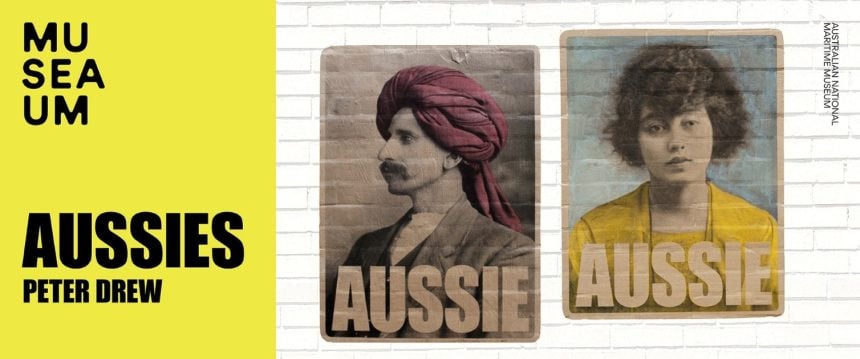
Peter Drew's poster series opens outdoors on 28 August
Peter Drew’s AUSSIES exhibition will open as a free outdoor display on 28 August at the Australian National Maritime Museum’s Wharf 7 forecourt.
The exhibition brings one of Australia’s most recognisable public art projects into an open-air setting at the museum. Visitors will be able to see the poster series in a shared public space rather than inside a gallery.
According to the museum, the display invites visitors and the broader community to reflect on Australian identity, belonging and the many migration stories that have shaped the nation.
Drew’s AUSSIE posters place archival portraits of culturally diverse people beside the word “AUSSIE”. The format asks viewers to reconsider who is included in Australia’s national story and what it means to belong.
The museum acquired Drew’s AUSSIE series in 2016 and added it to the National Collection that year.
Wharf 7 site links to migration monument
The outdoor exhibition will sit adjacent to the National Monument to Migration. That location ties the poster series to the museum’s work on migration, movement and connection.
Migration is one of the Australian National Maritime Museum’s key pillars. Through exhibitions, collections and public programs, the museum examines journeys that connected people to this continent by sea and the ways those journeys continue to shape Australia’s multicultural society.
Museum director and chief executive Daryl Karp AM said the exhibition creates “an important opportunity to open up respectful dialogue about multiculturalism and belonging”.
Karp also linked the show to the museum’s wider brief. She said the institution tells stories of arrival, settlement and contribution, and that those stories show how Australia has been shaped by people who came, built lives and belonged.
She described migration as an act of hope for safety, security, opportunity, education and a better life for children and family. As a result, the exhibition is framed around both personal journeys and collective histories.
Peter Drew explains the poster aim
Drew said, “the posters are an opportunity for people on the street to identify with the people in the posters.”
He said the work tries to create a moment of recognition between the viewer and the person in the image. In his words, that exchange can dissolve boundaries, even if only briefly.
The museum chose to present the exhibition outdoors and free to the public because it wants those conversations to happen in shared public space. However, it did not say how long the exhibition will run.